Brewer spruce
Picea breweriana S. Watson
Description
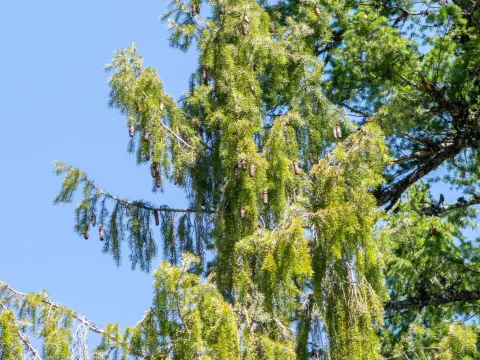
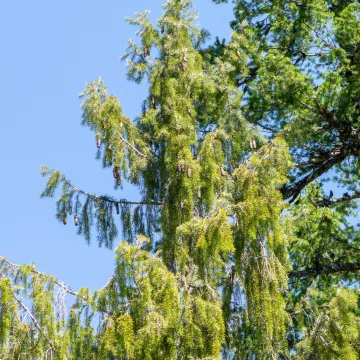
The Brewer spruce (Picea breweriana) is a unique evergreen coniferous tree belonging to the Pine family (Pinaceae). This species is widely considered one of the most decorative and rare members of the genus Picea, distinguished by its characteristic "weeping" canopy shape, which gives the tree a stunning and graceful appearance.
In the wild, this tree is native to a limited range in the Klamath Mountains, straddling the border of California and Oregon (USA). Under natural conditions, the spruce grows at elevations between 1000 and 2300 meters above sea level, preferring slopes protected from strong winds and areas with consistently high air humidity.
Botanically, the species is notable for its long, pendulous secondary branches that form a dense "veil" around the main trunk. The needles of the Brewer spruce are flat, dark green with silvery stomatal bands on the underside, which creates an attractive shimmering effect in the wind. The cones are large, cylindrical, and transition from purple to brown as they mature.
The species has specific agronomic requirements. It favors moist, well-drained, slightly acidic soils and does not tolerate waterlogging or prolonged drought. While generally hardy, the trees require protection from intense spring sun when young. Planting should be carried out in open or semi-shaded areas sheltered from desiccating winds.
The economic use of the Brewer spruce is purely ornamental. In landscape design, it is prized as a focal point in parks, botanical gardens, and large private estates. The main risks during cultivation involve fungal diseases (such as needle cast) in overly humid conditions and pests like spider mites or aphids, which necessitate regular preventive monitoring and insecticidal treatments.
Photo gallery