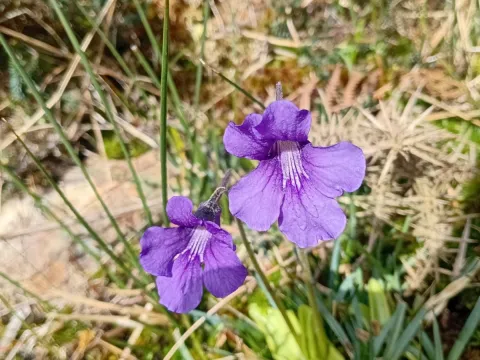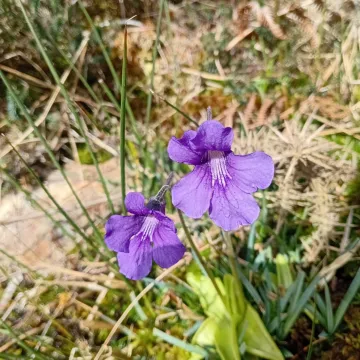
Large-flowered butterwort
Pinguicula grandiflora
Description
Large-flowered butterwort (Pinguicula grandiflora) is a carnivorous perennial herb belonging to the family Lentibulariaceae. This unique plant is often classified in niche horticulture as an insectivorous species, capturing small prey to supplement its nutrient uptake in nutrient-poor environments.
Originating from the mountainous regions of Western Europe, particularly the Pyrenees and the Alps, the species is native to damp rocky areas, stream banks, and boggy meadows. Its distribution is heavily dictated by water availability and specific soil types, usually occurring at high altitudes where the climate remains cool throughout most of the growing season.
The plant exhibits a basal rosette of greasy, glandular leaves designed to trap small insects. The most distinguishing botanical feature is its large, violet, spurred flower, which emerges in spring from the center of the rosette. During the colder winter months, the plant retreats into a tight resting bud, known as a hibernaculum, to survive the dormancy period.
Cultivation requirements are strict and revolve around mimicking its natural habitat. The substrate must be devoid of minerals and fertilizers, typically consisting of peat moss, perlite, and sand. Regular watering with distilled or rainwater is essential, as the species is highly sensitive to dissolved salts. High humidity and bright, indirect light are critical for maintaining healthy growth and flower production.
- Requires nutrient-free, acidic soil medium.
- Watering should be performed via a tray method with distilled water.
- Excellent ventilation is necessary to prevent fungal outbreaks.
- Dormancy period must be observed for longevity.
In practice, Pinguicula grandiflora is primarily managed by botanical enthusiasts and professional carnivorous plant nurseries. While it has limited traditional agricultural value, it serves as a natural pest control agent in greenhouses, reducing the population of fungus gnats. Common ailments include root rot and botrytis, typically triggered by improper irrigation habits or poor air circulation.
Photo gallery