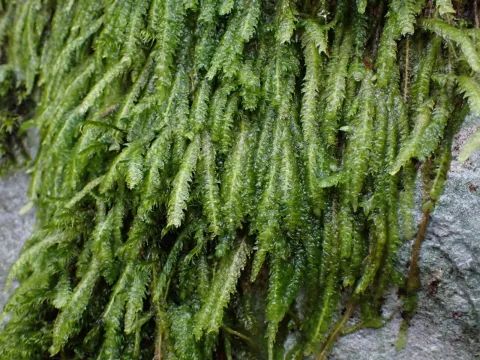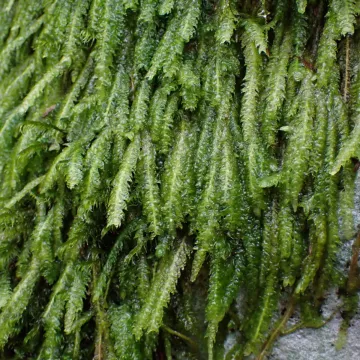
Wavy-leaved moss
Plagiothecium undulatum
Description
Plagiothecium undulatum, commonly known as the wavy-leaved moss, belongs to the family Plagiotheciaceae. While not a conventional agricultural crop, it is of significant interest in bryology, nursery horticulture, and ecological restoration, where its ability to cover large areas of forest floor is highly valued.
This species is native to temperate forests of the Northern Hemisphere, showing a preference for cool, moist environments. It is frequently found in old-growth coniferous woodlands, where it thrives on organic substrates such as decaying logs and acidic forest soil, often dominating the ground layer in shaded, sheltered microclimates.
The botanical structure of Plagiothecium undulatum is defined by its distinctively flat, creeping stems with overlapping, wavy-edged leaves. These leaves possess a characteristic glossy texture. The plant reproduces mainly through fragmentation and vegetative growth, as its sexual cycle depends heavily on precise humidity levels and suitable water film availability for fertilization.
Successful cultivation requires meticulous management of environmental conditions. The moss demands high ambient humidity and protection from direct sunlight, which causes immediate desiccation. The soil medium must remain consistently moist and slightly acidic, mimicking the conditions of a temperate rainforest floor. In greenhouse conditions, misting systems and shaded propagation benches are essential for maintaining viability.
Commercially, the wavy-leaved moss is used in specialty landscaping, such as terrariums, woodland garden features, and indoor moss walls. Beyond aesthetics, it serves as a critical bioindicator. Because it absorbs water and nutrients directly from the atmosphere and substrate, it is highly sensitive to sulfur dioxide and other air pollutants, making it a valuable tool for assessing regional forest health.
- Exceptional aesthetic value for woodland-themed landscaping.
- Highly sensitive bioindicator for air quality assessment.
- Valuable role in soil stabilization in humid forest ecosystems.
Photo gallery