
Stomp 330
БАСФ Агро БВ, Швейцарія, на заводі , Франція,Італія (Сієна)
710.8K 14 offers
13.2 €за 1 л ≈ 674 ₴


Herbicides, Desiccants
Чайна Кемікал Індасттріал і Рісеч Ко .,Лтд.,Гонконг,Китай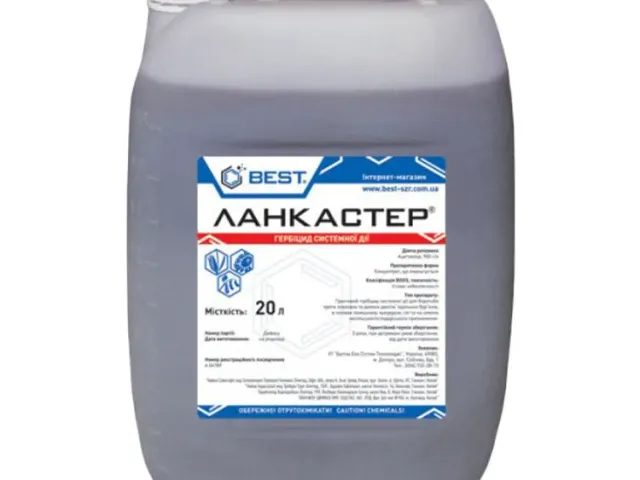
A reliable soil-applied barrier to protect soybeans, corn, and sunflowers from the first flush of annual weeds.
The success of row crop production—such as soybeans, corn, or sunflower—depends by 50% on how clean the field is at the start of the growing season. Competition with weeds during the first weeks of a plant's life always results in lost yield potential. The soil-applied herbicide Lancaster E.C. from China Chemical Industrial and Research Co., Ltd., is specifically designed to eliminate this problem before crop emergence.
The product is based on acetochlor. This is a systemic active ingredient that enters weeds through the coleoptile (in grasses) or hypocotyl (in broadleaf weeds). Crucially, the herbicide blocks cell division in the germinating weed, stopping its growth before it even breaks the soil surface.
Lancaster E.C. is a standard pre-emergence protection solution. To get the best results, agronomists recommend following these rules:
Using Lancaster E.C. allows the farmer to buy time. While the field is protected by the soil-applied herbicide, the crop has the chance to strengthen and develop a robust root system without wasting resources competing for moisture and light. One high-quality application per season effectively manages most annual broadleaf and grass weeds during the most critical period.
| Danger Class | 3 |
|---|---|
| Form of the preparation | |
|
By type of action
By type of action
Depending on their ability to move through living tissues, herbicides are divided into contact and systemic. Contact herbicides cause local damage to plant tissue upon contact, which dies or gradually degrades. This action does not always completely destroy the plant; often, its... |
|
|
By application method
By application method
Based on the method of application, herbicides are divided into foliar, soil, and root herbicides. Foliar herbicides are applied to vegetative plants and act through their above-ground organs. The main method of application for such preparations is spraying using sprayers or airp... |
|
|
By Mode of Action
By Mode of Action
Herbicides are divided into two groups according to their mode of action: Non-selective herbicides — intended for the destruction of all plant species. They are applied in agricultural fields during the absence of the main crop (after harvest, before crop emergence, on fallow lan... |
|
|
By Application Timing
By Application Timing
Herbicides are classified according to application timing into pre-emergent and post-emergent herbicides. Pre-emergent herbicides are mostly soil-applied or granular formulations applied before the emergence of crop plants. They are applied either pre-sowing (during pre-sowing cu... |
|
|
Maximum number of treatments
Maximum number of treatments
Maximum recommended number of treatments per vegetation period. |
1 |
| Catalog | Catalog → Herbicides, Desiccants |
| Manufacturer | Чайна Кемікал Індасттріал і Рісеч Ко .,Лтд.,Гонконг,Китай |
| Applicant | Брітіш Еко Сістем Текнолоджі, ІП |
| Country | China |
Aggregator catalog: prices are collected automatically from store websites, normalized by AI and converted at the current exchange rate. Before ordering, confirm the price and availability on the store's website. This block is not indexed by search engines — the data is loaded after the page opens.
Soybean · similar varieties


Often considered together with this variety





Similar items in this catalog section




Comments · 0