МА
26 June 2015
Перепутал.Опрыскал сад.Все умирает. Посоветуйте что делать.



Herbicides, Desiccants
DOW AgroSciences
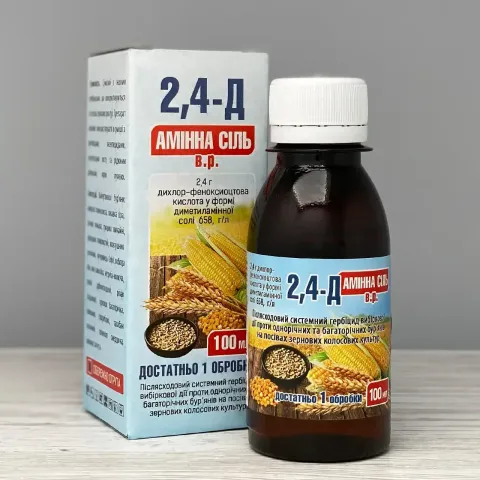
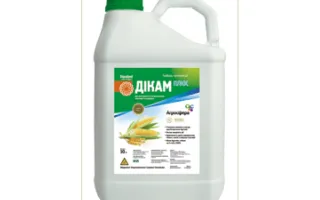
A reliable, selective systemic herbicide for effective weed control in cereals and corn.
When grain fields or corn rows start struggling with broadleaf weed pressure, agronomists turn to the reliable, time-tested solution from DOW AgroSciences. The 2,4-D Amine Salt is a systemic herbicide designed to selectively target and eliminate unwanted vegetation by disrupting their growth cycle. Its key advantage is selectivity: it effectively eliminates competition for water, sunlight, and nutrients while remaining safe for the primary crops.
This herbicide is best suited for controlling actively growing weeds in their early stages. The list of controlled weeds includes aggressive species like creeping thistle, white goosefoot, field mustard, wild radish, shepherd's purse, cleavers, and knotweed. Due to its systemic action, the active ingredient is absorbed through the leaves and translocated throughout the weed, ensuring complete control from the root up.
The formulation is a water-based solution, making it highly compatible with most other pesticides in tank mixes, which allows for multi-tasking during spraying operations. Given its 3rd class hazard level, it is a convenient choice for modern integrated pest management schedules.
For the best results with 2,4-D Amine Salt by DOW AgroSciences, pay close attention to weather conditions. The product works most effectively within a temperature range of +12°C to +25°C, when the weeds are in their most active vegetative state. Avoid applying during periods of frost or severe drought, as plant metabolism slows down under stress, potentially reducing the herbicide's effectiveness. By incorporating this product into your crop protection strategy, you ensure a clean field and protected yields with efficient, targeted weed management.
|
Last Processing Date, Days
Last Processing Date, Days
Number of days from processing to harvest cleanup |
1 |
|---|---|
|
By type of action
By type of action
Depending on their ability to move through living tissues, herbicides are divided into contact and systemic. Contact herbicides cause local damage to plant tissue upon contact, which dies or gradually degrades. This action does not always completely destroy the plant; often, its... |
|
|
By Mode of Action
By Mode of Action
Herbicides are divided into two groups according to their mode of action: Non-selective herbicides — intended for the destruction of all plant species. They are applied in agricultural fields during the absence of the main crop (after harvest, before crop emergence, on fallow lan... |
|
|
By Application Timing
By Application Timing
Herbicides are classified according to application timing into pre-emergent and post-emergent herbicides. Pre-emergent herbicides are mostly soil-applied or granular formulations applied before the emergence of crop plants. They are applied either pre-sowing (during pre-sowing cu... |
|
|
By application method
By application method
Based on the method of application, herbicides are divided into foliar, soil, and root herbicides. Foliar herbicides are applied to vegetative plants and act through their above-ground organs. The main method of application for such preparations is spraying using sprayers or airp... |
|
| Form of the preparation | |
|
Drug Consumption
Drug Consumption
Mass of the preparation per unit of treated area. It is customary to express the dosage rate in kilograms per hectare. The dosage rate is most often given in terms of 100% active ingredient, although sometimes it is calculated based on the preparation in the form of application w... |
From 0.5 - 1.0 L/ha |
|
Maximum number of treatments
Maximum number of treatments
Maximum recommended number of treatments per vegetation period. |
1 |
| Danger Class | 3 |
| Catalog | Catalog → Herbicides, Desiccants |
| Manufacturer | DOW AgroSciences |
| Country | USA |
Aggregator catalog: prices are collected automatically from store websites, normalized by AI and converted at the current exchange rate. Before ordering, confirm the price and availability on the store's website. This block is not indexed by search engines — the data is loaded after the page opens.
Common oat · similar varieties
Often considered together with this variety




Similar items in this catalog section









Comments · 4