


SKU #4307
·
1 258 views
Manchurian Beauty
Plum
User rating
2 votes100% positive reviews
No ratings yet — be the first.
Type of Sort
Chinese Loquat
Prices in stores
from3 895.1 €per 1000 pcs
3 offers from 3 stores
About product

Selected from seedlings of Chinese plum at the Yaomying station in Manchuria by gardener Ivanov. Sent to the Far East by A.A. Taratukhin, studied, propagated, and distributed by N.N. Tikhonov. According to some scientists, this variety combines characteristics of three plum species: Ussuri, Chinese, and Simon. From 1947, it was included in the catalogues of the Ural, Western Siberian, Far Eastern…
Type of Sort
Chinese Loquat
Description
Selected from seedlings of Chinese plum at the Yaomying station in Manchuria by gardener Ivanov. Sent to the Far East by A.A. Taratukhin, studied, propagated, and distributed by N.N. Tikhonov. According to some scientists, this variety combines characteristics of three plum species: Ussuri, Chinese, and Simon. From 1947, it was included in the catalogues of the Ural, Western Siberian, Far Eastern, and Eastern Siberian regions. It is found in gardens across Siberia, the Far East, and the European part of Russia.
The tree is a natural dwarf with a dense, rounded crown. The main type of fruiting is in clusters. Branches are brown-gray with peeling bark. The trunk is poorly expressed. Shoots are slightly curved, thin, brown-red, with a large number of light lenticels. It has high bud dormancy, leading to strong branching even in nurseries. Vegetative buds are small, oval; fruiting buds are large, oval. Leaves are small, 10.5 cm long and 4 cm wide, lanceolate or elliptic, dark green with a weak gloss. Leaf blade is concave, with a narrow, wedge-shaped base and acute tip, smooth, with serrated margins and slightly curved main vein, oriented downward. Petiole is dark anthocyanic. Each bud contains 3 flowers. They open before the leaves. Flowers are very small, white.
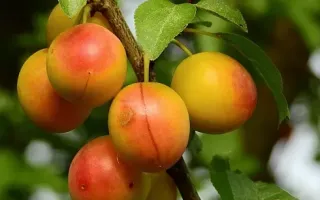
Fruits are round, medium-sized (15 g), with a flat base and deep, narrow depression. The ventral suture is not pronounced. Main color is yellow-orange, almost entirely covered by a diffuse dark burgundy blush with an intense bluish bloom. Skin is medium density, flavorless. Flesh is yellow-green, loose, juicy, moderately firm, slightly acidic-sweet, with a slight aroma and good taste. Stone is medium size, ovate-acuminate, well-formed, semi-detached from the flesh. Peduncle is short, with fairly strong attachment to the fruit.
Fruits ripen at the end of August to the beginning of September. They contain 17-24% dry matter, 8-15% sugars, 0.9-1.7% titratable acids, 0.37-0.41% tannins, 7-9 mg/100g ascorbic acid, 325-350 mg/100g P-active substances. It is a universal variety.
Begins fruiting in the 3rd year after planting as a one-year-old seedling. Fruit production is moderate. Regarding winter hardiness of the tree and fruit buds, it is inferior to most Ussuri plum varieties. It is drought-tolerant, resistant to clasterosporiosis and red blotch, susceptible to moniliosis. Not resistant to fruit rot. Self-sterile.
It transmits its valuable traits well to offspring. With its participation, A.N. Venyaminov created varieties Zarya and Sestra Zari; G.T. Kazymin created Khabarowskaya Rannaya, Amurskaya Rannaya, Kolhoznitsa, Galka, Skazka, Kateryna, Kruptonoplodnaya; at the Institute of Horticulture — Pamyati Dutova, Chemalskaya.
Video · 3 videos
Suggest a video →Crop & resistance
Crop
Disease resistance
Specifications
| Type of Sort | |
|---|---|
| Catalog | Catalog → Plum |
Store offers · 3 from 3 stores
Prices are updated on loadLoading offers…
Aggregator catalog: prices are collected automatically from store websites, normalized by AI and converted at the current exchange rate. Before ordering, confirm the price and availability on the store's website. This block is not indexed by search engines — the data is loaded after the page opens.
Alternatives
European plum · similar varieties




See also
Often considered together with this variety




Recently viewed
Similar items in this catalog section


Comments · 0