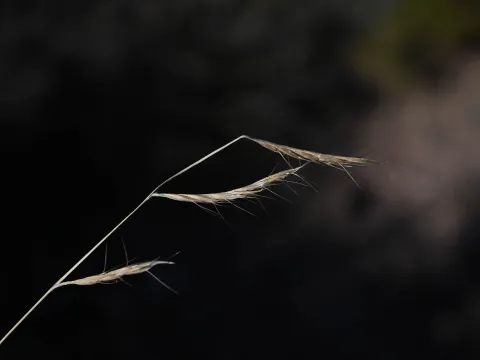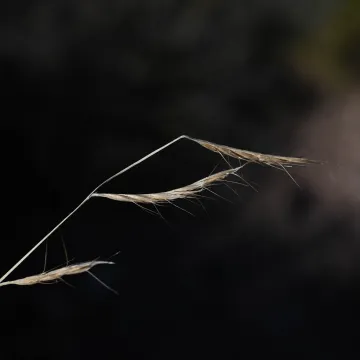
Black grama
Bouteloua eriopoda (Torr.) Torr.
Description
Black grama (Bouteloua eriopoda) is a perennial grass species belonging to the Poaceae family. It is widely recognized as one of the most important forage grasses in the arid rangelands of the Southwestern United States and Northern Mexico.
The origin of the species is linked to the desert grasslands where it thrives despite irregular rainfall and extreme summer temperatures. It plays a crucial ecological role in maintaining soil stability and preventing desertification in fragile arid landscapes.
Botanically, Black grama is characterized by its stoloniferous growth habit, meaning it spreads through horizontal stems that root at the nodes. The stems and leaves are covered with dense, woolly hairs, which provide a distinctive appearance and function as an adaptation to reduce water loss through evaporation.
Regarding cultivation requirements, the species is highly adapted to sandy and gravelly soils with excellent drainage. Agronomic management involves careful rotational grazing, as the plant is sensitive to overgrazing during periods of severe drought, which can significantly reduce its ability to recover.
Economically, it is valued for its year-round nutritional quality. Even when dormant during winter, its forage remains highly palatable and nutritious for cattle. The plant faces few major diseases or insect pests, largely because its native environment is too harsh for most common crop pathogens to thrive extensively.
- Excellent forage palatability throughout all seasons.
- Strong erosion control properties.
- High tolerance to heat and water scarcity.
- Ability to regenerate through vegetative stolons.
Photo gallery