Jack pine
Pinus banksiana Lamb.
Description
Jack pine (Pinus banksiana Lamb.) is a coniferous species within the Pinaceae family. It is widely recognized for its ecological resilience, particularly its ability to colonize nutrient-poor sites and areas prone to fire. As a hardy evergreen, it serves as a staple in forestry management across vast northern territories.
The species originates from North America, with an extensive range spanning from the Atlantic coast to the Northwest Territories. It typically thrives in regions with sandy or gravelly soils where other conifer species struggle to survive. Its biological adaptation to fire, specifically serotinous cones, allows it to dominate landscapes post-disturbance.
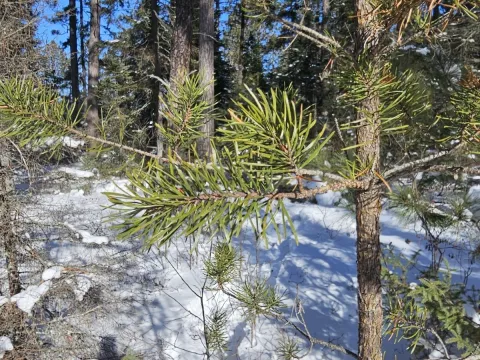
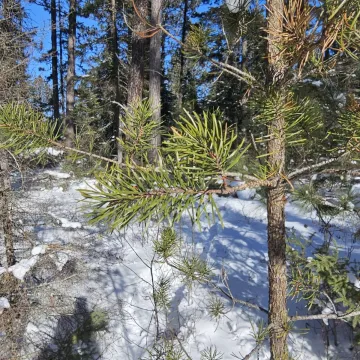
Botanically, the Jack pine is distinguished by its short, divergent needles found in pairs and asymmetrical, curved cones that can persist on branches for years. The tree usually reaches heights of 15 to 25 meters under favorable conditions, though its habit can vary from upright to shrubby in harsh, windswept environments. The bark is typically thin, flaky, and grayish-brown.
In terms of cultivation, Jack pine requires full sun and thrives in well-drained, acidic soil. It is exceptionally drought-tolerant once established. Modern silviculture focuses on site preparation and minimizing weed competition during the juvenile phase to ensure rapid stand development and uniform growth patterns in commercial forests.
Economically, this species is vital for the pulp and paper industry due to its fiber characteristics. It is also utilized for rough construction lumber, utility poles, and as a key species for land reclamation projects. Management involves monitoring for common pests like the jack pine budworm and diseases such as needle cast or various rusts that can impact timber quality.
- Excellent performance on nutrient-poor sandy soils.
- High tolerance to cold temperatures and drought.
- Significant utility in paper and pulp production.
- Essential for forest reclamation and windbreak planting.
Photo gallery