Jeffrey pine
Pinus jeffreyi Balf.
Description
The Jeffrey pine (Pinus jeffreyi) is a large evergreen conifer belonging to the family Pinaceae. It is a long-lived tree species recognized for its robust structure and its unique feature: the bark, when warmed by the sun, emits a distinct scent often described as a mix of vanilla and butterscotch or lemon.
Native to the western part of North America, the species thrives primarily in California, Oregon, and northern Mexico. It is commonly found in mountain environments, often inhabiting high-altitude zones where it withstands harsh climates, thin soils, and significant seasonal variations in temperature.
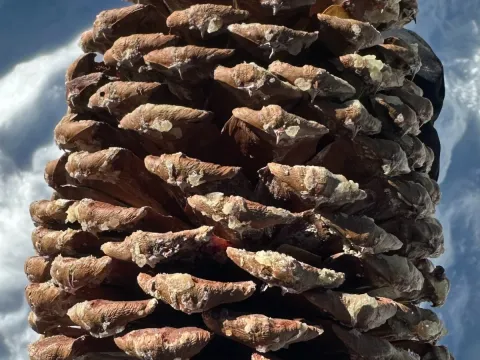
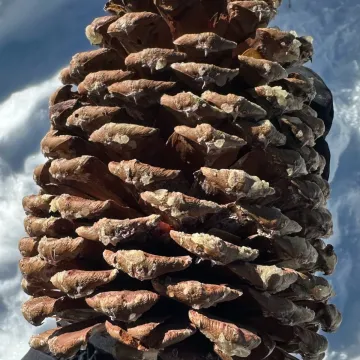
Botanically, the tree is distinguished by its needle-like leaves grouped in threes, which are generally longer than those of its close relative, the ponderosa pine. Its cones are large and egg-shaped, featuring prickles on the cone scales that point inward, making them smooth to the touch when brushed from the base toward the tip.
Regarding cultivation requirements, the Jeffrey pine prefers well-drained, nutrient-poor, or rocky soils. It is highly drought-tolerant once established and requires full sunlight for optimal growth. Avoid planting in locations prone to waterlogging, as the root system is susceptible to decay if the soil remains excessively moist for extended periods.
In terms of land use, the timber is utilized in the construction industry due to its strength and durability. In landscaping, it is favored for its architectural silhouette. To maintain healthy trees, gardeners and foresters should monitor for common pests and pathogens, including:
- pine engraver beetles;
- dwarf mistletoe;
- various rust fungi;
- pine needle scale;
- root rot pathogens in heavy soils.
Photo gallery