Austrian pine
Pinus nigra J. F. Arnold
Description
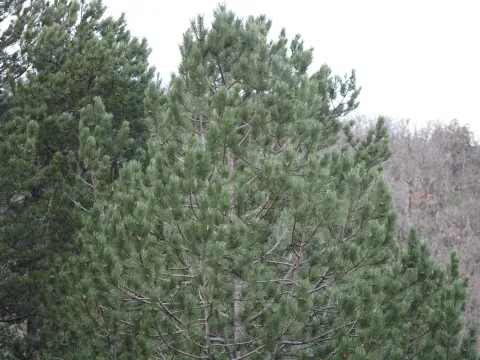
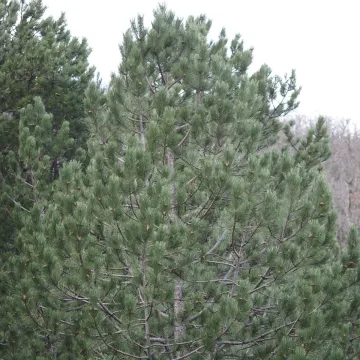
The Austrian pine (Pinus nigra) is a prominent conifer species within the Pinaceae family. Renowned for its dark, rugged bark and dense, dark green needles, this tree is a staple in both forestry and ornamental landscaping. It is highly valued for its robust growth habit and its ability to thrive in diverse and often challenging environmental conditions.
The species originates from Southern and Central Europe, ranging from the Mediterranean to the mountains of Asia Minor. Its natural distribution is largely defined by mountainous terrains and limestone landscapes. Due to its historical resilience, it has been introduced widely across North America and other temperate regions for reforestation, windbreaks, and urban aesthetic improvement.
Botanically, Pinus nigra is characterized by its stiff, paired needles that can reach up to 15 cm in length and remain on the tree for several years. The cones are light brown, ovoid, and provide a distinct ornamental feature. The tree typically reaches 20 to 40 meters in height, exhibiting a pyramidal shape in youth that matures into a broader, irregular crown.
Regarding agrotechnical requirements, the Austrian pine is remarkably adaptable. It is highly drought-tolerant once established and demonstrates significant resistance to air pollution, making it an excellent candidate for urban forestry. It prefers well-drained soils and full sun exposure. While it thrives on limestone substrates, it can tolerate a variety of soil textures provided they are not excessively waterlogged.
The economic and practical usage of the Austrian pine is diverse. The wood is dense and durable, suitable for various construction applications. In horticulture, it is favored for its screening properties and its ability to act as an effective windbreak. Common pests and diseases include European pine sawfly and needle cast fungus, which require standard integrated pest management practices to maintain tree health.
Photo gallery