


SKU #3968
·
203 views
Ruby
Cherry, Sour Cherry
User rating
0 votes0% positive reviews
No ratings yet — be the first.
Type of Sort
Cherry
Prices in stores
from352.9 €per 1000 pcs
7 offers from 5 stores
About product

Selected by the All-Union Institute of Fruit Growing named after N.I. Vavilov in 1933 from cherry bushes near the village of Obsharovka in Samara region under the name Stepnoy No. 7. Transferred to state variety testing in 1947, it has been under regional evaluation since 1974. Included in the State Register for the Northwestern Region (Leningrad Oblast). A bush or small tree up to 2.5 m tall, wi…
Type of Sort
Cherry
Description
Selected by the All-Union Institute of Fruit Growing named after N.I. Vavilov in 1933 from cherry bushes near the village of Obsharovka in Samara region under the name Stepnoy No. 7. Transferred to state variety testing in 1947, it has been under regional evaluation since 1974. Included in the State Register for the Northwestern Region (Leningrad Oblast).
A bush or small tree up to 2.5 m tall, with a broad, spreading, and fairly dense crown. Usually forms a short trunk with gray, cracked bark, from which main branches extend at acute angles, with brown bark and a grayish-white bloom. One-year branches are slightly curved, with brown coloration. Vegetative buds are acute-conical, generative buds — obtuse-conical. Leaves are large, 111 x 51 mm, dark green, leathery, shiny, ranging from elongated-oval to inversely egg-shaped, with an elongated acute apex and rounded base; leaf margins are doubly-toothed; petioles 17-20 mm long, with anthocyanin tint; stipules usually two, orange, located either on the petiole at the base of the leaf blade or at the base of the leaf blade. Flowers in clusters of 3-4, 30 mm in diameter, with flat corolla and weakly fringed, broadly oval, bifid at the apex petals. Calyx is cup-shaped, light green with anthocyanin tint. Stigma is 11-12 mm long, stigma positioned above the anthers, stamens 6-10 mm. Pedicel 27-35 mm. Fruit set is mixed: 40% of yield forms on one-year branches, 60% — on flower clusters of 2-3-year-old branches.
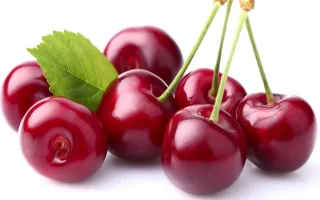
Fruits are medium to slightly above medium size, 18 x 20 x 19 mm, weighing 3.5 g, bright red, round, slightly compressed vertically and along the ventral suture, with rounded apex and wide, fine pit, with ventral suture appearing as a blurred dark line. Flesh is yellowish, juicy and tender, sweet-sour, satisfactory flavor, with astringency in underripe condition, juice uncolored. Fruits contain 12.4% dry matter, 8.8% sugars, 1.5% free acids, 16.8 mg ascorbic acid per 100 g fresh weight. Pit is medium size, 9.5 x 8 x 6.5 mm, weighing 0.24 g, making up 7% of total fruit mass, broadly egg-shaped, yellow, smooth, with pointed apex, rounded base, separates well from flesh. Peduncle 30-40 mm, very firmly attached to fruit, separates with peeling skin and juice exudation.
Grafted plants begin fruiting 2-3 years after planting. In terms of flowering and ripening, it belongs to the mid-late group: in Leningrad Oblast, flowering begins on average May 30, ripening — at the beginning of August. From the start of flowering to the beginning of ripening takes an average of 62 days, fruits ripen over 10-15 days. Self-sterile, best pollinators are Vladimirskaya and Otechestvennaya. Yield is very unstable year by year. Over 10 years of fruiting in Leningrad Oblast, average yield was 78.8 kg per tree, with individual trees yielding up to 20-23 kg in some years. In southern fruit-growing zones, average yield over 10 years of fruiting from 10-19-year-old trees was 74.6 kg. The variety shows satisfactory cold and winter hardiness, with average bud damage over 10 years of 2.5 points, branch damage — 1 point. In years favorable for disease development, it is significantly (up to 3-4 points) affected by coccomycosis and slightly — by moniliosis. In some years, it is affected by the sticky fruit worm.
Due to its characteristic features — yellow flesh and uncolored juice, excessive acidity, wet detachment of fruits from peduncles, insufficient cold and winter hardiness, susceptibility to coccomycosis — it is recommended only for amateur gardens. Fruits are limitedly used for processing, so they are recommended for table use in full ripeness.
Advantages: compact plant habit, bright red, decorative fruits.
Disadvantages: insufficient cold and winter hardiness, susceptibility to coccomycosis, wet detachment of fruits from peduncles, low transportability, limited use as a table variety.
Video · 3 videos
Suggest a video →Crop & resistance
Crop
Specifications
| Type of Sort | |
|---|---|
| Catalog | Catalog → Cherry, Sour Cherry |
Store offers · 7 from 5 stores
Prices are updated on loadLoading offers…
Aggregator catalog: prices are collected automatically from store websites, normalized by AI and converted at the current exchange rate. Before ordering, confirm the price and availability on the store's website. This block is not indexed by search engines — the data is loaded after the page opens.
Alternatives
Sweet cherry · similar varieties




See also
Often considered together with this variety






Recently viewed
Similar items in this catalog section


Comments · 0