МА
12 April 2016
скажите пожалуйста какова цена




Herbicides, Desiccants
MONSANTO
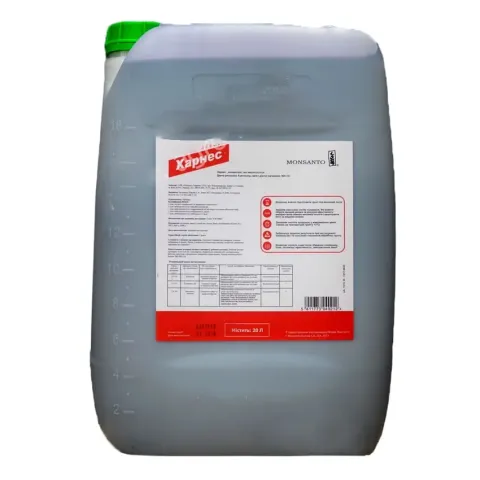
A reliable soil-applied barrier that blocks the development of annual grasses and broad-leaved weeds before they emerge.
The efficiency of the soil-applied herbicide Harness from Monsanto is rooted in the fundamental properties of acetochlor, an active ingredient from the chloroacetamide family. As a selective systemic herbicide, its primary function is to block the early developmental stages of weed vegetation even before the crop emerges.
The core of Harness’s operation is the inhibition of protein and nucleic acid synthesis within the meristematic tissues of weed seedlings. Due to its systemic activity, the preparation is absorbed by the coleoptiles of germinating grasses and the hypocotyls of broad-leaved weeds. Consequently, the weed perishes at the moment of germination or shortly after contact with the treated soil layer. For an agronomist, this translates to the absence of competition for nutrients during the critical vegetation stage.
The product is applied once as a pre-emergence herbicide. The dosage varies from 2.0 to 3.0 L/ha depending on the soil type (heavier, humus-rich soils require higher rates). Given its Hazard Class 2 rating, strict adherence to personal protective equipment standards and application rules is a mandatory safety requirement.
|
Last Processing Date, Days
Last Processing Date, Days
Number of days from processing to harvest cleanup |
1 |
|---|---|
|
By type of action
By type of action
Depending on their ability to move through living tissues, herbicides are divided into contact and systemic. Contact herbicides cause local damage to plant tissue upon contact, which dies or gradually degrades. This action does not always completely destroy the plant; often, its... |
|
|
By Mode of Action
By Mode of Action
Herbicides are divided into two groups according to their mode of action: Non-selective herbicides — intended for the destruction of all plant species. They are applied in agricultural fields during the absence of the main crop (after harvest, before crop emergence, on fallow lan... |
|
|
By Application Timing
By Application Timing
Herbicides are classified according to application timing into pre-emergent and post-emergent herbicides. Pre-emergent herbicides are mostly soil-applied or granular formulations applied before the emergence of crop plants. They are applied either pre-sowing (during pre-sowing cu... |
|
|
By application method
By application method
Based on the method of application, herbicides are divided into foliar, soil, and root herbicides. Foliar herbicides are applied to vegetative plants and act through their above-ground organs. The main method of application for such preparations is spraying using sprayers or airp... |
|
| Form of the preparation | |
|
Drug Consumption
Drug Consumption
Mass of the preparation per unit of treated area. It is customary to express the dosage rate in kilograms per hectare. The dosage rate is most often given in terms of 100% active ingredient, although sometimes it is calculated based on the preparation in the form of application w... |
From 2.0 - 3.0 L/ha |
|
Maximum number of treatments
Maximum number of treatments
Maximum recommended number of treatments per vegetation period. |
1 |
| Danger Class | 2 |
| Catalog | Catalog → Herbicides, Desiccants |
| Manufacturer | MONSANTO |
| Country | USA |
Aggregator catalog: prices are collected automatically from store websites, normalized by AI and converted at the current exchange rate. Before ordering, confirm the price and availability on the store's website. This block is not indexed by search engines — the data is loaded after the page opens.
Fruit crops · similar varieties


Often considered together with this variety





Similar items in this catalog section





Comments · 3