Field dodder
Cuscuta campestris Yunck.
Description
Field dodder (Latin Cuscuta campestris) is a highly aggressive parasitic annual weed belonging to the Convolvulaceae family. It is distinct in that it lacks roots and true leaves, functioning entirely as a parasite that draws water and nutrients from host plants through specialized structures known as haustoria.
Originally native to North America, field dodder has become a globally distributed plant. It now colonizes a vast range of environments, effectively infesting a wide spectrum of agricultural crops, including legumes, ornamental plants, vegetables, and fruit trees, often causing severe economic losses in infested areas.
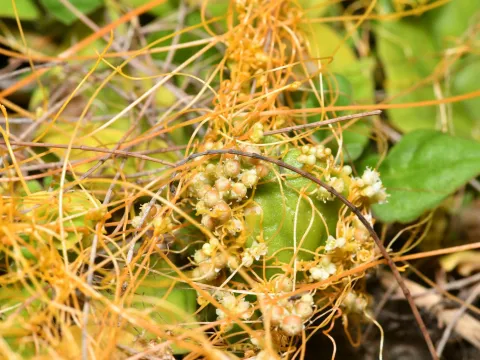
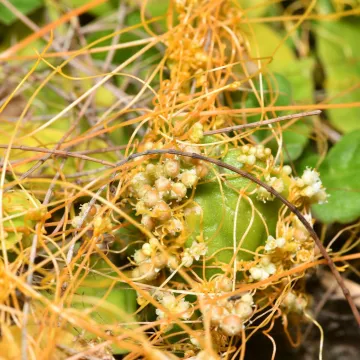
Botanically, it appears as a mass of thin, yellow-to-orange filaments that twine around host stems. Its seeds are exceptionally resilient, capable of remaining dormant in the soil for years and resisting various environmental stresses. This durability, combined with its small size, makes the seeds extremely difficult to filter out from agricultural grain and seed supplies.
Regarding cultivation and environment, dodder thrives in warm, sunny conditions with adequate moisture. Agronomic control relies heavily on integrated management, including the use of certified parasite-free seeds, strict quarantine enforcement, effective crop rotation, and the prompt removal and destruction of infested crop patches before the dodder flowers and produces seeds.
The economic impact of field dodder is significant; it drastically reduces plant vigor and crop yields. Furthermore, it is a known vector for various plant viruses, which complicates crop management. Because of its destructive nature, agricultural industries treat field dodder as a serious threat that requires constant vigilance and proactive weed control programs.
Photo gallery