Five-angled dodder
Cuscuta pentagona Engelm.
Description
The five-angled dodder (Cuscuta pentagona Engelm.) is a highly specialized parasitic plant belonging to the Convolvulaceae family. Unlike standard agricultural crops, it lacks chlorophyll, roots, and true leaves, making it completely dependent on host plants for survival, water, and nutrients.
Originally native to North America, the species has since spread across various temperate and tropical regions worldwide. It is currently recognized as a major invasive species and a regulated quarantine pest in numerous countries, as its infestation can devastate crop yields and compromise field health for years.
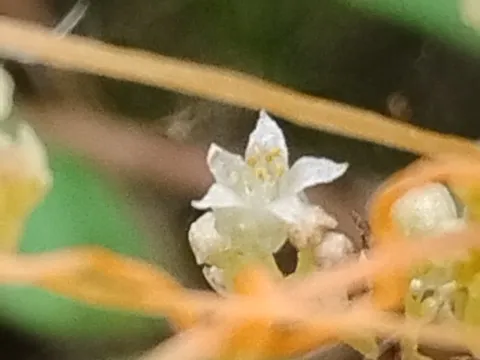
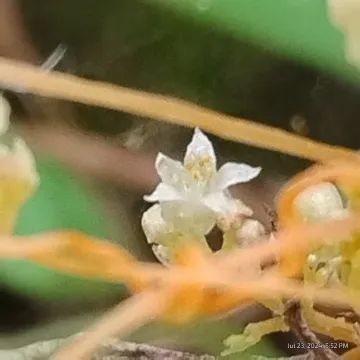
Its botanical structure consists of delicate, thread-like stems in shades of yellow or pale orange. The plant attaches itself to a host using haustoria—specialized root-like structures that penetrate the stems of the host plant to siphon off carbohydrates and water. The plant blooms with small, whitish flowers and produces vast quantities of seeds that can remain dormant in the soil for a long period.
The agronomic requirements for this weed are minimal, as it thrives in any environment where suitable host plants, such as alfalfa, clover, or vegetable crops, are present. Effective management strategies involve strict adherence to weed-free seed certification, deep mechanical tillage, crop rotation, and the rapid eradication of initial infection sites to prevent widespread dispersal.
There are no positive agricultural or economic uses for this plant; it is strictly categorized as a noxious weed. It significantly reduces agricultural production, causes heavy yield losses, and can harbor various viral pathogens. Its ability to spread through seeds, stems, and equipment makes it one of the most difficult weeds for farmers to control in modern agriculture.
Photo gallery