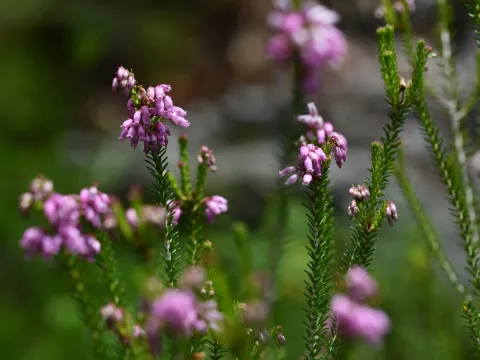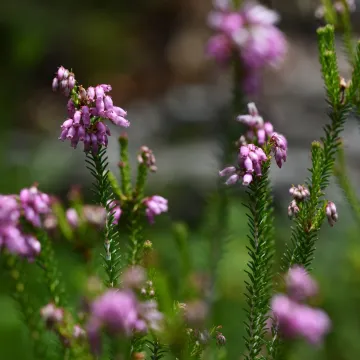
Corsican heath
Erica terminalis Salisb.
Description
Corsican heath (Erica terminalis Salisb.) is a robust, evergreen shrub belonging to the Ericaceae family. It is widely recognized in professional horticulture for its dense, upright growth habit and its reliability as a perennial landscaping element that maintains its structure throughout the year.
The native distribution of this species is centered in the western Mediterranean, with significant populations found in Corsica and Sardinia. Its evolutionary history in these rocky, nutrient-poor environments has equipped the plant with high tolerance for drought and thin soils, making it an excellent candidate for specific xeriscaping projects.
Botanically, the plant is characterized by its whorled, needle-like foliage that creates a fine-textured appearance. The most striking features are the terminal clusters of pink to reddish-purple bell-shaped flowers. These inflorescences emerge mid-summer and retain their structure well into autumn, eventually drying into a persistent russet-brown that adds winter interest.
Cultivation requires adherence to strict soil parameters to ensure plant longevity. The primary requirement is an acidic soil medium with a pH range between 4.5 and 5.5. Drainage is the most critical factor; the root system is highly sensitive to hypoxia, so planting in raised beds or sandy, well-aerated substrates is essential for success.
- Placement in full sun to partial shade for optimal flowering.
- Routine maintenance involving mulching with acidic organic matter.
- Annual pruning post-flowering to prevent the base from becoming woody and sparse.
- Winter protection in colder climates to prevent desiccation.
In terms of agricultural and horticultural use, this species is primarily utilized for ornamental landscaping, particularly in heather gardens and rockeries. While generally hardy, the plant can be susceptible to root rot pathogens like Phytophthora if drainage is inadequate. Pest issues are relatively minor but may include infestations of spider mites or scale insects during prolonged periods of drought.
Photo gallery