
Iris domestica
Iris domestica Goldblatt & Mabb.
Description
Iris domestica, taxonomically reclassified from the genus Belamcanda, is a fascinating perennial plant belonging to the Iridaceae family. Known commonly as the blackberry lily or leopard lily, it is highly valued for its striking appearance and historical significance in Eastern traditional medicine. The plant is distinct for its rhizomatous root system and unique reproductive cycle.
Originating from East Asia, including regions like China, Japan, and India, the plant has a wide natural distribution in open meadows and rocky slopes. Over time, its cultivation has spread globally, as it is prized in temperate climates for its drought tolerance once established and its ability to bring an exotic aesthetic to garden beds and herbaceous borders.
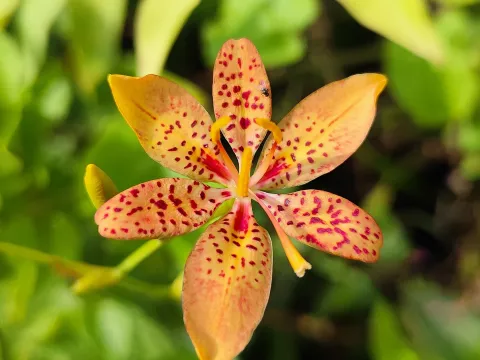
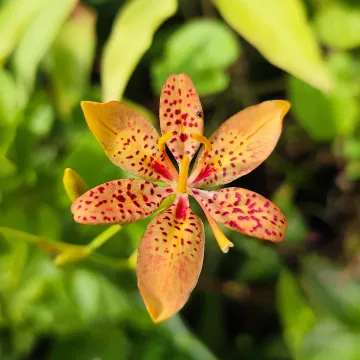
Botanically, the plant displays flat, fan-shaped leaves typical of the iris family. Its flowers bloom in shades of orange or yellow with distinct dark spots, appearing throughout the summer. The most notable feature occurs after fertilization, when the seed pods split open to reveal clustered, shiny black seeds that mimic the look of blackberries, providing visual interest well into the autumn.
For successful cultivation, Iris domestica requires well-draining soil and a location that receives full to partial sun. While it can withstand some heat, protection from excessively damp winters is essential to prevent root rot. It is relatively easy to propagate from seeds, which can be sown directly in spring, and it thrives in soil pH levels that are neutral to slightly alkaline.
The economic and practical uses of this species are diverse. Primarily, it is an ornamental staple in landscaping. Additionally, the rhizomes contain compounds studied for their medicinal properties, often utilized in traditional practices to treat respiratory ailments. Common pests include aphids and mites, while bacterial soft rot remains a significant threat if the soil remains waterlogged for prolonged periods.
Photo gallery