




SKU #841
·
2 101 views
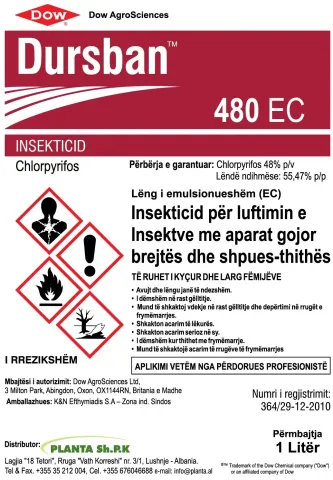
Durban 480
Insecticides, Acaricides
DOW AgroSciencesUser rating
0 votes0% positive reviews
No ratings yet — be the first.
Last Processing Date, Days
30
Maximum number of treatments
2
Method of Application
Spraying by vegetation
Form of the preparation
Emulsion concentrate
About product

A powerful insecto-acaricide with a strong fumigation effect for rapid pest control in the most demanding field conditions.
Last Processing Date, Days
30
Maximum number of treatments
2
Method of Application
Spraying by vegetation
Form of the preparation
Emulsion concentrate
Description
Why Dursban 480 remains the "heavy artillery" of crop protection
In the world of modern agrochemistry, where many products are shifting towards narrow specialization, Dursban 480 from DOW AgroSciences continues to hold its ground as a classic "all-rounder." Its key advantage lies in the combination of high contact strength and a fumigation effect, allowing for the control of hidden pests that systemic insecticides cannot always reach.
Strengths and Mechanism of Action
The active ingredient, chlorpyrifos (organophosphate group), acts as a cholinesterase inhibitor. For an agronomist, this means an immediate "knockdown effect": the pest is paralyzed almost instantly upon contact or ingestion.
- Targeting hidden pests: Due to its fumigation properties, the product effectively penetrates bark crevices or soil litter, where weevils or cutworms hide.
- Mite control: Unlike many common insecticides, Dursban 480 successfully manages spider mites, expanding its application profile for fruit crops.
- Broad spectrum: From wireworms and Colorado potato beetles to phytonomus, it covers both surface-dwelling and soil-borne pests.
Application nuances and safety
Given its Hazard Class 2 rating and significant toxicity, this product requires strict adherence to safety protocols. The emulsifiable concentrate should be applied evenly, preferably during morning or evening hours with favorable weather conditions. The dosage ranges from 1.0 to 3.0 L/ha, depending on the phytosanitary pressure and the specific crop.
It is important to remember that Dursban 480 is a tool for professionals who understand the risks. The 30-day pre-harvest interval restricts its use in early growth stages or on crops with short maturation cycles. It is the optimal choice for protecting sugar beets, apples, and potatoes during high pest infestation scenarios, where rapid population suppression is required to prevent critical crop loss.
Composition
Active ingredients
- Chlorpyrifos инсектицид Фосфорорганические
Application
Used on crops
Specifications hover over for a hint about the specification
|
Last Processing Date, Days
Last Processing Date, Days
Number of days from processing to harvest cleanup |
30 |
|---|---|
|
Maximum number of treatments
Maximum number of treatments
Maximum recommended number of treatments per vegetation period. |
2 |
|
Method of Application
Method of Application
Seed treatment — treatment of seeds before sowing. Soil treatment — application of pesticides to soil, for example, in greenhouses. Seed treatment — a preparation used for pre-sowing treatment of seeds of various crops to protect seedlings from plant diseases and pests. In some c... |
|
| Form of the preparation | |
|
Drug Consumption
Drug Consumption
Mass of the preparation per unit of treated area. It is customary to express the dosage rate in kilograms per hectare. The dosage rate is most often given in terms of 100% active ingredient, although sometimes it is calculated based on the preparation in the form of application w... |
From 1.0 - 2.0 L/ha, From 2.0 - 3.0 L/ha |
|
Type of Action
Type of Action
Insecticides are divided into contact, systemic, stomach, and fumigants based on their mode of entry into the organism. Contact insecticides affect insects upon contact with any part of their body, penetrating into their organism through the integument. They are used against pest... |
|
| Danger Class | 2 |
| Catalog | Catalog → Insecticides, Acaricides |
| Manufacturer | DOW AgroSciences |
| Country | USA |
Store offers · 5 from 5 stores
Prices are updated on loadLoading offers…
Aggregator catalog: prices are collected automatically from store websites, normalized by AI and converted at the current exchange rate. Before ordering, confirm the price and availability on the store's website. This block is not indexed by search engines — the data is loaded after the page opens.
Alternatives
Fodder beet · similar varieties




SuperBison
«Юнісіті Ентерпрайсіс Л.П.», Единбург, Великобританія
01.7K 17 offers
5.5 €за 1 л ≈ 281 ₴
See also
Often considered together with this variety


Recently viewed
Similar items in this catalog section

Borey
ЗАТ Фірма Август, Росія.,селище Вурнари,
From your browsing history
27.5K 9 offers
17.6 €за 1 л ≈ 899 ₴


Tabu
ZAT «August-Bel», Republic of Belarus
From your browsing history
45.8K 4 offers
9.8 €за 1 л ≈ 500 ₴



Comments · 0