


SKU #4299
·
283 views
Katunskaya
Plum
User rating
0 votes0% positive reviews
No ratings yet — be the first.
Type of Sort
Chinese Loquat
Prices in stores
from5 574.7 €per 1000 pcs
2 offers from 2 stores
About product

This variety was developed at the NIISS named after M.A. Lisavенко in the mountainous zone of the Altai (Chemal village) by selecting seedlings from open pollination of Ulmus ussuriensis. Authors: V.S. Putov, T.M. Pletneva (Tsypetsavver). It is widely grown in gardens of the Altai region. Included in the State Register in 1965 for the West Siberian region. Trees are low-growing with a flat-round,…
Type of Sort
Chinese Loquat
Description
This variety was developed at the NIISS named after M.A. Lisavенко in the mountainous zone of the Altai (Chemal village) by selecting seedlings from open pollination of Ulmus ussuriensis. Authors: V.S. Putov, T.M. Pletneva (Tsypetsavver). It is widely grown in gardens of the Altai region. Included in the State Register in 1965 for the West Siberian region.
Trees are low-growing with a flat-round, non-dense crown. Branches are gray, emerging from skeletal branches at an obtuse angle. The trunk is low. Shoots are straight, reddish-brown. Vegetative buds are conical, fruiting buds are rounded. Leaves are medium-sized, egg-shaped, with a long, curved tip, dark green, smooth, matte, with a smooth margin and fine serrated edges. The leaf blade is nearly flat, hairless, with a short, reddish petiole. Two to three flowers are located in the bud. Flowers are small, white, cup-shaped, blooming before the leaves.
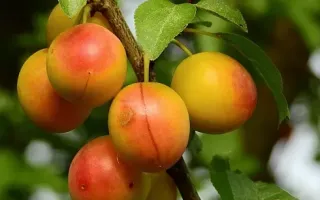
Fruits are small (10-15 g), oval, with a narrow, deep, oval depression divided by a groove and a well-defined ventral seam, evenly arranged. Main color is pale yellow, covered with a weak golden blush and a whitish waxy coating. No skin spots. The peduncle is short, easily separates from the branches, and ripe fruits easily fall off. Skin has barely noticeable bitterness. Flesh is light-yellow, tender, very juicy, loose, sweet, slightly acidic, with good flavor. Pit is medium-sized, oval, smooth, with two grooves, well-formed, easily separates from the flesh.
Fruits ripen in mid-August. Once removed from the tree, they quickly lose market appearance, developing brown spots. Not suitable for storage or transportation. They contain 16-19% soluble solids, 7.3-14% sugars, 1.5-1.7% titratable acids, 0.37-0.51% tannins, 6-12 mg/100g ascorbic acid, and 235-327 mg/100g P-active substances. Variety is of universal use.
Enters fruiting on the 3rd-4th year after planting as one-year seedlings. Winter hardiness of the tree is satisfactory, fruit buds are above average. Yield is high, irregular. Affected moderately by Clasterosporium and fruit moth, significantly by Maslov's seed-eater. Susceptible to rot. Self-sterile.
In selection terms, it is unlikely to be of interest, as among its numerous offspring, no plants have been identified that surpass the mother variety in fruit size or taste qualities.
Crop & resistance
Crop
Disease resistance
Specifications
| Type of Sort | |
|---|---|
| Catalog | Catalog → Plum |
Store offers · 2 from 2 stores
Prices are updated on loadLoading offers…
Aggregator catalog: prices are collected automatically from store websites, normalized by AI and converted at the current exchange rate. Before ordering, confirm the price and availability on the store's website. This block is not indexed by search engines — the data is loaded after the page opens.
Alternatives
European plum · similar varieties




See also
Often considered together with this variety




Recently viewed
Similar items in this catalog section


Comments · 0