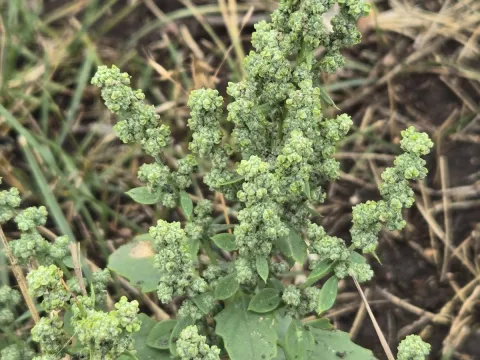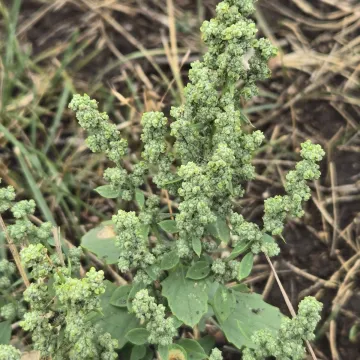
Pitseed goosefoot
Chenopodium berlandieri Moq.
Description
Pitseed goosefoot (lat. Chenopodium berlandieri) is an annual herbaceous plant belonging to the Amaranthaceae family. Historically, this species served as a staple crop for indigenous populations in North America, functioning as a vital pseudo-cereal. It is part of a group of plants that formed the foundation of early agricultural societies, often referred to as the Eastern Agricultural Complex.
The native range of this plant encompasses wide areas of North and Central America. Historically, it was cultivated in diverse environments, ranging from river valleys to more arid highland regions. Today, it is primarily recognized for its ethnobotanical importance and its potential as a sustainable crop in contemporary agricultural systems that prioritize biodiversity and climate resilience.
Botanically, the plant is characterized by a sturdy, branching stem, often growing between 1 and 1.5 meters. The foliage is frequently covered in a mealy, powdery substance, which is a specialized adaptation to reduce water loss. The plant produces dense clusters of small, dark, protein-rich seeds that develop in terminal and axillary spikes, showcasing high reproductive potential.
Agricultural success depends on providing full sun exposure and well-draining, nutrient-rich soil. While the crop is remarkably plastic regarding soil pH, it thrives best in conditions that prevent waterlogging. Cultivation practices typically involve shallow sowing in late spring, consistent weed management during the seedling stage, and ensuring appropriate spacing to maximize air circulation and nutrient uptake.
The primary agricultural output is the seed, which is processed to remove saponins before human consumption. It can be used in porridge, baking, or as a dense protein supplement. Potential threats to crop health include common agricultural pests like aphids and leaf miners, as well as fungal infections like downy mildew, which can be mitigated through proper crop rotation and site selection.
Photo gallery