



SKU #4459
·
236 views
Nadina
Currant
User rating
0 votes0% positive reviews
No ratings yet — be the first.
Type of Sort
Blackcurrant
About product

Mid-season ripening variety, developed at the All-Russian Research Institute of Fruit Crop Selection from crossing the varieties Oryolskaya Yubileynaya and Primorsky Velykan. Authors: T.P. Ogoltsova, L.V. Bayanova. Included in the State Register of Varieties approved for use in the Northwestern Region in 1998.
Plant is tall, upright, and slightly spreading. Growing shoots are straight, thick,…
Type of Sort
Blackcurrant
Description
Mid-season ripening variety, developed at the All-Russian Research Institute of Fruit Crop Selection from crossing the varieties Oryolskaya Yubileynaya and Primorsky Velykan. Authors: T.P. Ogoltsova, L.V. Bayanova. Included in the State Register of Varieties approved for use in the Northwestern Region in 1998.
Plant is tall, upright, and slightly spreading. Growing shoots are straight, thick, greenish, matte, and hairy. Woody shoots are thick with a thick golden-brown tip, long internodes, gray, and weakly glossy. Buds are large, thick, egg-shaped with a blunt tip, pinkish, more vivid at shoot tips, arranged parallel to the shoot. Terminal bud is non-free (with 2-3 equal buds), leaf scar shape is wedge-shaped.
Leaf is five-lobed, large, light green, deeply wrinkled, folded, with sharp lobes. Middle lobe is longer than side lobes, massive, broad-triangular, with barely noticeable additional protrusions. Side lobes are fairly long, sharp, widely spaced, their upper sides lie on one line, lower sides sharply angled, angle between their midribs is obtuse. Notches between lobes are obtuse. Basal lobes are vaguely defined, their veins directed towards the petiole. Leaf base has a narrow, deep, open notch. Teeth are large and blunt, petiole bluish-purple.
Flowers are large, bell-shaped, calyx lobes reddish, not fused, slightly curled. Inflorescences are medium-sized (up to 7.0 cm), dense, hanging, axis thin, petiole hairy and long.
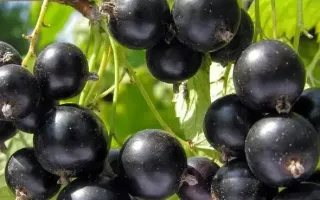
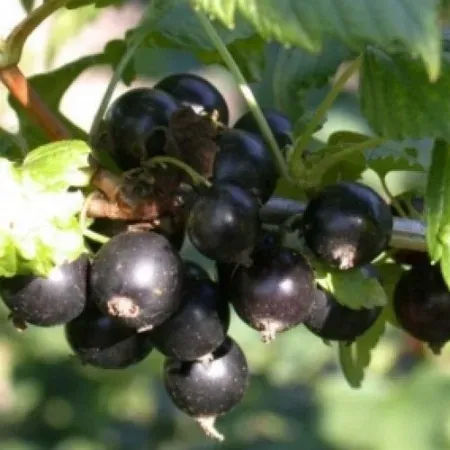
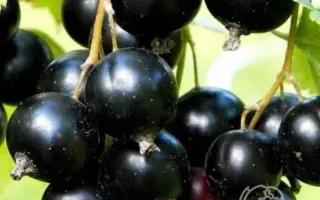
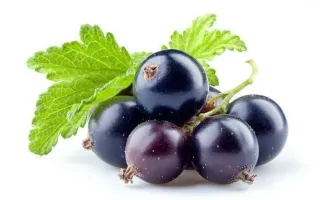
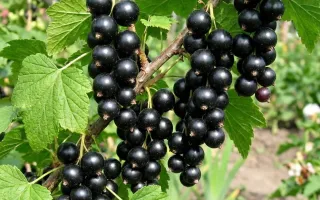
Berries are large (1.6 g), one-dimensional, round, black, with average seed count, sour-sweet flavor (4.5 points). Receptacle is round, medium-sized, open or semi-open, pedicel medium-length, slightly curved. Chemical composition: dry matter — 12.6%, sugar sum — 7.8%, titratable acidity — 3.0%, ascorbic acid — 246.8 mg/100 g, anthocyanins — 211.9 mg/100 g, leucoanthocyanins — 239.6 mg/100 g, catechins — 326.7 mg/100 g, total P-active substances — 778.2 mg/100 g.
Variety is winter-hardy, early-bearing, self-fertile (61%), resistant to powdery mildew, anthracnose, septoria, and bud mite, suitable for mechanical harvesting, average yield 7.2 t/ha (1.1 kg/plant).
Advantages of the variety: comprehensive field resistance to diseases and bud mite, high technological efficiency.
Disadvantages of the variety: insufficient resistance to spider mite, low resistance to high temperatures and drought.
Crop & resistance
Crop
Disease resistance
Pest resistance
Specifications
| Type of Sort | |
|---|---|
| Catalog | Catalog → Currant |
Store offers · 1 from 1 stores
Prices are updated on loadLoading offers…
Aggregator catalog: prices are collected automatically from store websites, normalized by AI and converted at the current exchange rate. Before ordering, confirm the price and availability on the store's website. This block is not indexed by search engines — the data is loaded after the page opens.
Alternatives
Currants · similar varieties


See also
Often considered together with this variety







Recently viewed
Similar items in this catalog section




Comments · 0