



SKU #4440
·
926 views
Lazy
Currant
User rating
1 vote100% positive reviews
No ratings yet — be the first.
Type of Sort
Blackcurrant
About product

Medium-late maturing variety, developed at the All-Russian Research Institute of Fruit Crop Selection from a cross between the varieties 'Bredtorp' and 'Minay Shmyrev'. Breeders: T.P. Ogoltsova, S.D. Knyazev, L.V. Bayanova. Included in the State Register of Varieties Approved for Use in the Northwestern, Central, Volga-Vyatka, and Middle Volga regions in 1995.
Strong, vigorous, moderately spre…
Type of Sort
Blackcurrant
Description
Medium-late maturing variety, developed at the All-Russian Research Institute of Fruit Crop Selection from a cross between the varieties 'Bredtorp' and 'Minay Shmyrev'. Breeders: T.P. Ogoltsova, S.D. Knyazev, L.V. Bayanova. Included in the State Register of Varieties Approved for Use in the Northwestern, Central, Volga-Vyatka, and Middle Volga regions in 1995.
Strong, vigorous, moderately spreading, dense bush. Growing shoots are thick, green, shiny. Woody shoots are gray with a light-brown tint toward the tips, glabrous, shiny, thick, evenly tapering toward the top, with long internodes. Buds are medium-sized, rose-violet, asymmetric, conical with a pointed apex, deviated from the shoots. Terminal bud is free; leaf scar shape is rounded-triangular or triangular.
Leaf is five-lobed, large, green, slightly wrinkled, smooth, slightly shiny. Central lobe is larger than lateral lobes, with additional protrusions, broad-triangular. Lateral lobes are short, sharp, angle between their veins is acute or straight. Upper sides of lateral lobes lie on a straight line or at an acute angle to the central vein; lower sides are angled toward the base. Deep, sharp indentations between lobes. Basal lobes are well-defined, veins directed toward the leaf apex or spread out. Base has an open, wide, medium-depth notch. Teeth are small, serrated, broad; petiole is long, thick, colored, glabrous.
Flowers are medium-sized, bell-shaped, calyx lobes reddish, slightly curved downward. Inflorescences are long (up to 8.0 cm), hanging, with central axis; pedicels are hairy and long.
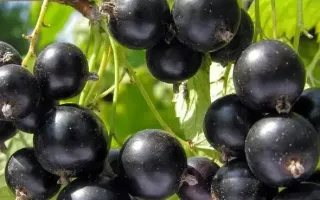
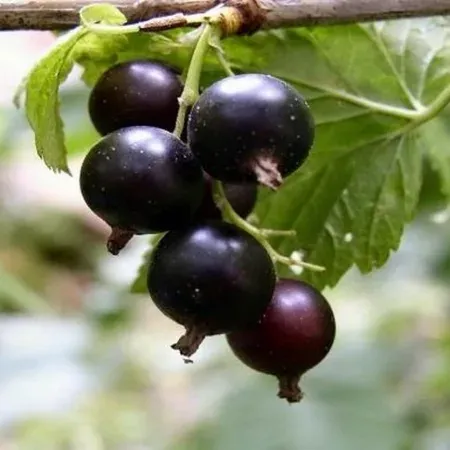
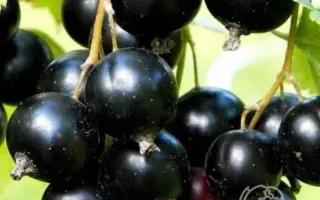
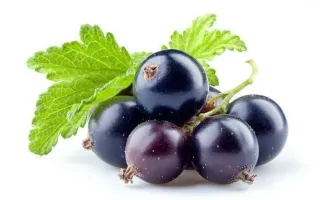
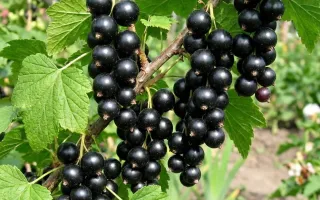
Berries are large (2.1 g), round, black, with a brownish tint, non-uniform, sweet flavor (4.8 points), refreshing. Calyx is rounded, small or medium-sized, half-open; pedicel is medium-length and slightly curved. Chemical composition: total dry matter — 13.7%, total sugars — 8.8%, titratable acidity — 2.8%, ascorbic acid — 117.4 mg/100 g, anthocyanins — 115.4 mg/100 g, leucoanthocyanins — 321.0 mg/100 g, catechins — 237.9 mg/100 g, total P-active substances — 674.3 mg/100 g.
Winter-hardy variety, with good self-fertility (43%), resistant to anthracnose, septoria, and flower malformation, susceptible to powdery mildew, moderately resistant to rust and bud mite. Suitable for mechanized harvest, average yield 6.6 t/ha (0.9 kg/plant).
Advantages of the variety: late ripening, dessert berry flavor, resistance to anthracnose, septoria, and flower malformation, technological suitability.
Disadvantages of the variety: uneven berry ripening, susceptibility to powdery mildew, unstable yield.
Video · 4 videos
Suggest a video →Crop & resistance
Crop
Disease resistance
Specifications
| Type of Sort | |
|---|---|
| Catalog | Catalog → Currant |
Store offers · 3 from 3 stores
Prices are updated on loadLoading offers…
Aggregator catalog: prices are collected automatically from store websites, normalized by AI and converted at the current exchange rate. Before ordering, confirm the price and availability on the store's website. This block is not indexed by search engines — the data is loaded after the page opens.
Alternatives
Currants · similar varieties



See also
Often considered together with this variety







Recently viewed
Similar items in this catalog section




Comments · 0