




SKU #3908
·
242 views
Kentish
Cherry, Sour Cherry
User rating
0 votes0% positive reviews
No ratings yet — be the first.
Type of Sort
Cherry
About product

Kentish Red, Early Richmond
An old English variety, widely grown in Western Europe, little known in Russia. According to many morphological and biological characteristics, it is a plum-cherry hybrid. Included in the State Register for the Central Black Earth and Lower Volga regions; registered since 1947.
A strongly growing tree; in its youth the crown is pyramidal, reaching 4 m in height by a…
Type of Sort
Cherry
Description
Kentish Red, Early Richmond
An old English variety, widely grown in Western Europe, little known in Russia. According to many morphological and biological characteristics, it is a plum-cherry hybrid. Included in the State Register for the Central Black Earth and Lower Volga regions; registered since 1947.
A strongly growing tree; in its youth the crown is pyramidal, reaching 4 m in height by age 10, then becomes rounded. The main branches are upward-sloping, emerging from the trunk at angles of 45-60°, with dark brown coloration with a grayish tint. Shoots are slightly curved, gray-brown. Leaves are above-average or large (106 x 48 mm), oval, dark green, matte, slightly folded along the main vein; margins smooth with fine doubly-serrated teeth; apex gradually pointed, base broad-angled; petiole 18-25 mm long, up to 2 mm thick; glands greenish-yellow, located 1-2 on the petiole near the base of the leaf blade; small, awl-shaped, falling stipules. Flowers in clusters of 2-4, 26-28 mm in size, bowl-shaped; petals 9 x 7 mm, broadly oval, with a split apex, overlapping each other; stigma 6 mm, located below the anthers; stamens 7-10 mm; calyx cup-shaped, green with anthocyanin tint on the sun-facing side; pedicel 23-32 mm. Fruit set is mixed, the majority of the crop forms on cluster branches.
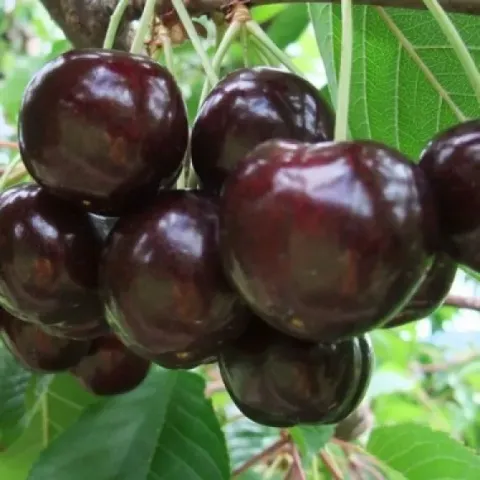
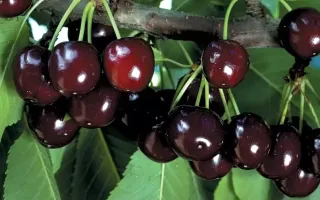
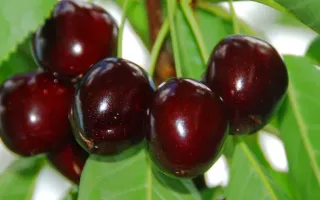
Fruit medium-sized - 19.3 x 19.5 x 17.0 mm, weighing 2.5-3.0 g, round, slightly compressed vertically, dark red, with a rounded apex and narrow, fine indentation; flesh tender, dark red, sweet-tart, good flavor, juice red. In the Krasnodar region, the flesh contains: dry matter - 16.5%, sugars - 11.8%, free acids - 1.4%, ascorbic acid - 4.8 mg per 100 g of fresh weight. Stone 8 x 6 x 5 mm, weighing 0.2 g, constitutes 8.4% of the fruit's mass, light brown, broadly oval, with a pointed apex, sharp dorsal and weakly developed ventral sutures, easily separates from the flesh. Peduncle 40-45 mm, 1 mm thick, moderately firmly attached to the fruit. Fruit are of universal use, suitable for high-quality jam production.
Plants begin to bear fruit late - on the 5th-6th year after planting. Regarding flowering and ripening, it belongs to early varieties, fruits ripen 20 days earlier than the 'Lyubskaya' plum. Partially self-fertile; best pollinators are 'Vladimirskaya' and 'Griot Ostgheim'. Productivity is average, at 8-10 years old 15-18 kg per tree, in favorable years during full fruiting reaching 30-40 kg. Winter hardiness is good in normal winters; in severe (-27.4°C) conditions, shoot damage may be 1.4 points, generative buds up to 30%. Shows moderate field resistance to coccomycosis, in some years infection level reaches 4 points.
The 'Kentish' variety is of interest primarily for amateur gardening in central and southern fruit-growing regions of Russia.
Advantages of the variety: dark red, high-quality fruit.
Disadvantages: small fruit size, becoming more evident with tree age; late fruiting onset and insufficient cold resistance.
Crop & resistance
Crop
Disease resistance
Specifications
| Type of Sort | |
|---|---|
| Catalog | Catalog → Cherry, Sour Cherry |
Store offers · 2 from 2 stores
Prices are updated on loadLoading offers…
Aggregator catalog: prices are collected automatically from store websites, normalized by AI and converted at the current exchange rate. Before ordering, confirm the price and availability on the store's website. This block is not indexed by search engines — the data is loaded after the page opens.
Alternatives
Sweet cherry · similar varieties





See also
Often considered together with this variety







Recently viewed
Similar items in this catalog section


Comments · 0