





SKU #4350
·
188 views
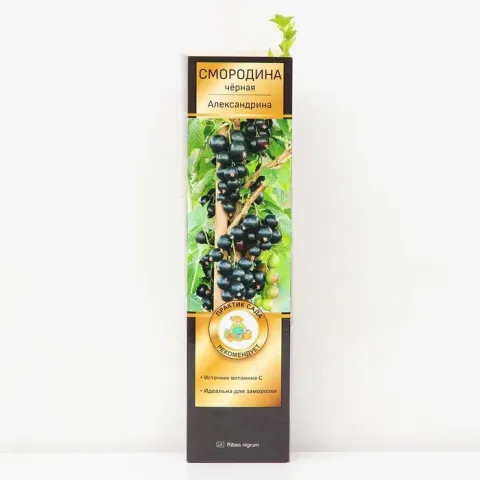
Alexandrina
Currant
User rating
0 votes0% positive reviews
No ratings yet — be the first.
Type of Sort
Blackcurrant
Prices in stores
from3 557.3 €per 1000 pcs
4 offers from 3 stores
About product

Mid-late maturing variety, developed at Pavlovsk Experimental Station of the All-Russian Research Institute of Plant Growing named after N.I. Vavilov from crossing varieties Nagrad and Ojebin. Authors: E.V. Volodina, S.P. Khotimskaya, O.A. Tikhonova. Included in the State Register of Varieties approved for use in the Northwest region in 2008.
Medium-height bush, slightly spreading during fruit…
Type of Sort
Blackcurrant
Description
Mid-late maturing variety, developed at Pavlovsk Experimental Station of the All-Russian Research Institute of Plant Growing named after N.I. Vavilov from crossing varieties Nagrad and Ojebin. Authors: E.V. Volodina, S.P. Khotimskaya, O.A. Tikhonova. Included in the State Register of Varieties approved for use in the Northwest region in 2008.
Medium-height bush, slightly spreading during fruiting, sparse. Growing shoots of medium thickness, straight or slightly curved, green or slightly unevenly colored, hairy. Woody shoots of medium thickness, evenly tapering to the tip, curved, brown with brown tips, hairy. Buds single, large, egg-shaped or rounded-conical with pointed tips, pink or pink-purple, hairy, deviated. Terminal bud free, conical or cylindrical with pointed tips, large, hairy. Leaf scar shape wedge-shaped.
Leaf five-lobed, medium, green with yellowing, shiny, slightly wrinkled, dense, hairy along veins on both upper and lower leaf surfaces; in the area of the petiole notch on the upper side of the leaf — with denser, woolly hairs. Leaf blade slightly concave along the midrib, positioned at an acute angle to the shoot. Main veins uncolored. Central lobe narrow, elongated, triangular with pointed tip and weakly expressed additional protrusions. Side lobes narrow, sharp, triangular, spreading outward, their veins directed at an acute or right angle. Basal lobes clearly defined, their veins directed towards the petiole. Base with open, rounded notch of moderate depth. Teeth small, shallow, sharp, saw-toothed and double-saw-toothed, with a small but clearly distinguishable "claw". Petiole of medium length, bluish-green, with anthocyanin coloring along the entire length in the upper part of the shoot, hairy.
Flowers medium, cup-shaped, pink and pink-purple. Sepals free, egg-shaped and oval, rounded at the tip, slightly curved, slightly hairy. Petals oval and egg-shaped, uncolored, slightly inclined towards the pistil. Pistil slightly higher than stamens. Inflorescences short and medium (3.2-5.5 cm), with sparse berry placement (5-6 berries), axis bluish-green, hairy (more intense hairiness in the middle and at the tip of the inflorescence). Pedicels long, medium thickness and thin, hairy, bluish-green.
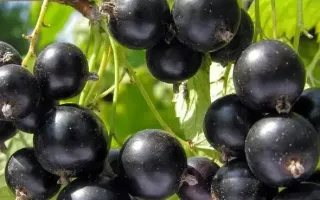
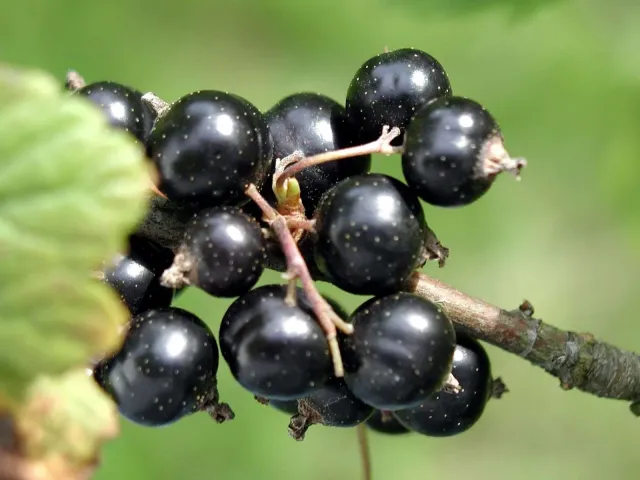
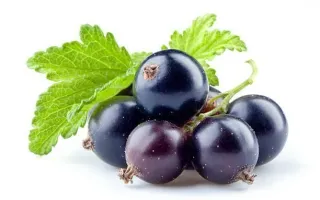
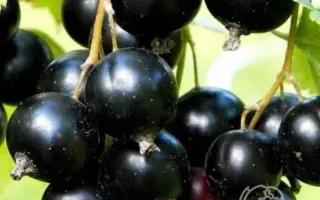
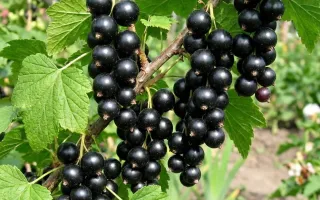
Berries medium to large (0.9-1.2 g), round and oval, black, hairy (mostly at the base of the calyx), shiny, with dense, not thick skin and small, falling, closed calyx. In some berries the calyx on the tip may be slightly "frayed". Berries contain on average 30 medium-sized seeds. Detachment easy, dry. Taste sour-sweet (4.5 points), with very strong aroma. In processed products retains typical blackcurrant aroma of fresh berries. Berries of universal use. Chemical composition: dry matter — 21.2%, sugar sum — 12.2%, titratable acidity — 3.1%, ascorbic acid — 175.1 mg/100 g, P-active substances — 309.0 mg/100 g, pectic substances (on fresh weight) — 1.0%. Leaves contain up to 4722.9 mg/100 g bioactive phenolic compounds.
Highly winter-hardy, early-bearing, self-fertile (71.9%), average yield 1.8-3.0 kg/plant, resistant to powdery mildew and bud mite, weakly affected by anthracnose and septoria. On root shoots during growth and development forms up to 84% mixed buds.
Advantages of the variety: high resistance to fungal diseases and bud mite, excellent taste and commercial qualities of berries, preservation of taste and typical aroma in processed products, good transportability, easy, dry detachment of berries.
Disadvantages of the variety: at high resistance to bud mite may be affected by double-flowering.
Video · 1 video
Suggest a video →Crop & resistance
Crop
Disease resistance
Pest resistance
Specifications
| Type of Sort | |
|---|---|
| Catalog | Catalog → Currant |
Store offers · 4 from 3 stores
Prices are updated on loadLoading offers…
Aggregator catalog: prices are collected automatically from store websites, normalized by AI and converted at the current exchange rate. Before ordering, confirm the price and availability on the store's website. This block is not indexed by search engines — the data is loaded after the page opens.
Alternatives
Currants · similar varieties


See also
Often considered together with this variety







Recently viewed
Similar items in this catalog section




Comments · 0