ЕЛ
2 July 2023
Где можно купить ТАРГА?


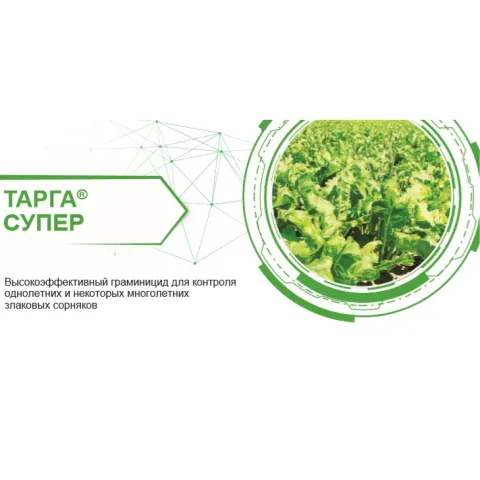

Herbicides, Desiccants
Nissan Chemical Corporation, LLC
Systemic selective herbicide for efficient grass weed control in vegetable and industrial crops with a short pre-harvest interval.
For growers dealing with heavy grass weed pressure, finding a selective solution that won't damage the crop is essential. Targa Super, developed by Nippon Chemical Corporation (Ніссан Кемікал Корпорейшн), is a systemic herbicide designed to eliminate grass weeds while keeping your crops healthy. It is a go-to tool for managing fields infested with couch grass (Elymus repens), green foxtail, and cereal volunteers.
Targa Super is highly effective across a diverse range of crops, including onions, garlic, celery, fodder beets, winter rapeseed, cabbage, hemp, and peppers. Its selective nature ensures that broad-leaved vegetables and technical crops remain untouched while the systemic formula travels deep into the grass weeds, killing them from the roots up.
As a systemic herbicide, Targa Super is absorbed through the leaves, ensuring rapid action even if weather conditions are variable. It comes as an emulsifiable concentrate, which is easy to mix for standard field applications. The recommended rate ranges from 2.0 to 3.0 liters per hectare.
Planning your agricultural operations is straightforward: the pre-harvest interval is only 1 day. This makes Targa Super an ideal solution for intensive vegetable production where timing is everything. Please note that it is classified as a Hazard Class 2 product, so always utilize standard protective gear during preparation and application. Whether you are managing small garden plots or large commercial fields, this Japanese-formulated herbicide provides the reliability needed for high-yield farming.
|
Last Processing Date, Days
Last Processing Date, Days
Number of days from processing to harvest cleanup |
1 |
|---|---|
|
By type of action
By type of action
Depending on their ability to move through living tissues, herbicides are divided into contact and systemic. Contact herbicides cause local damage to plant tissue upon contact, which dies or gradually degrades. This action does not always completely destroy the plant; often, its... |
|
|
By Mode of Action
By Mode of Action
Herbicides are divided into two groups according to their mode of action: Non-selective herbicides — intended for the destruction of all plant species. They are applied in agricultural fields during the absence of the main crop (after harvest, before crop emergence, on fallow lan... |
|
|
By Application Timing
By Application Timing
Herbicides are classified according to application timing into pre-emergent and post-emergent herbicides. Pre-emergent herbicides are mostly soil-applied or granular formulations applied before the emergence of crop plants. They are applied either pre-sowing (during pre-sowing cu... |
|
|
By application method
By application method
Based on the method of application, herbicides are divided into foliar, soil, and root herbicides. Foliar herbicides are applied to vegetative plants and act through their above-ground organs. The main method of application for such preparations is spraying using sprayers or airp... |
|
| Form of the preparation | |
|
Drug Consumption
Drug Consumption
Mass of the preparation per unit of treated area. It is customary to express the dosage rate in kilograms per hectare. The dosage rate is most often given in terms of 100% active ingredient, although sometimes it is calculated based on the preparation in the form of application w... |
From 2.0 - 3.0 L/ha |
| Danger Class | 2 |
|
Maximum number of treatments
Maximum number of treatments
Maximum recommended number of treatments per vegetation period. |
1 |
| Catalog | Catalog → Herbicides, Desiccants |
| Manufacturer | Nissan Chemical Corporation, LLC |
| Applicant | Nissan Chemical Corporation, LLC |
| Country | Japan |
Aggregator catalog: prices are collected automatically from store websites, normalized by AI and converted at the current exchange rate. Before ordering, confirm the price and availability on the store's website. This block is not indexed by search engines — the data is loaded after the page opens.
Onion · similar varieties
Often considered together with this variety




Similar items in this catalog section




Comments · 2